

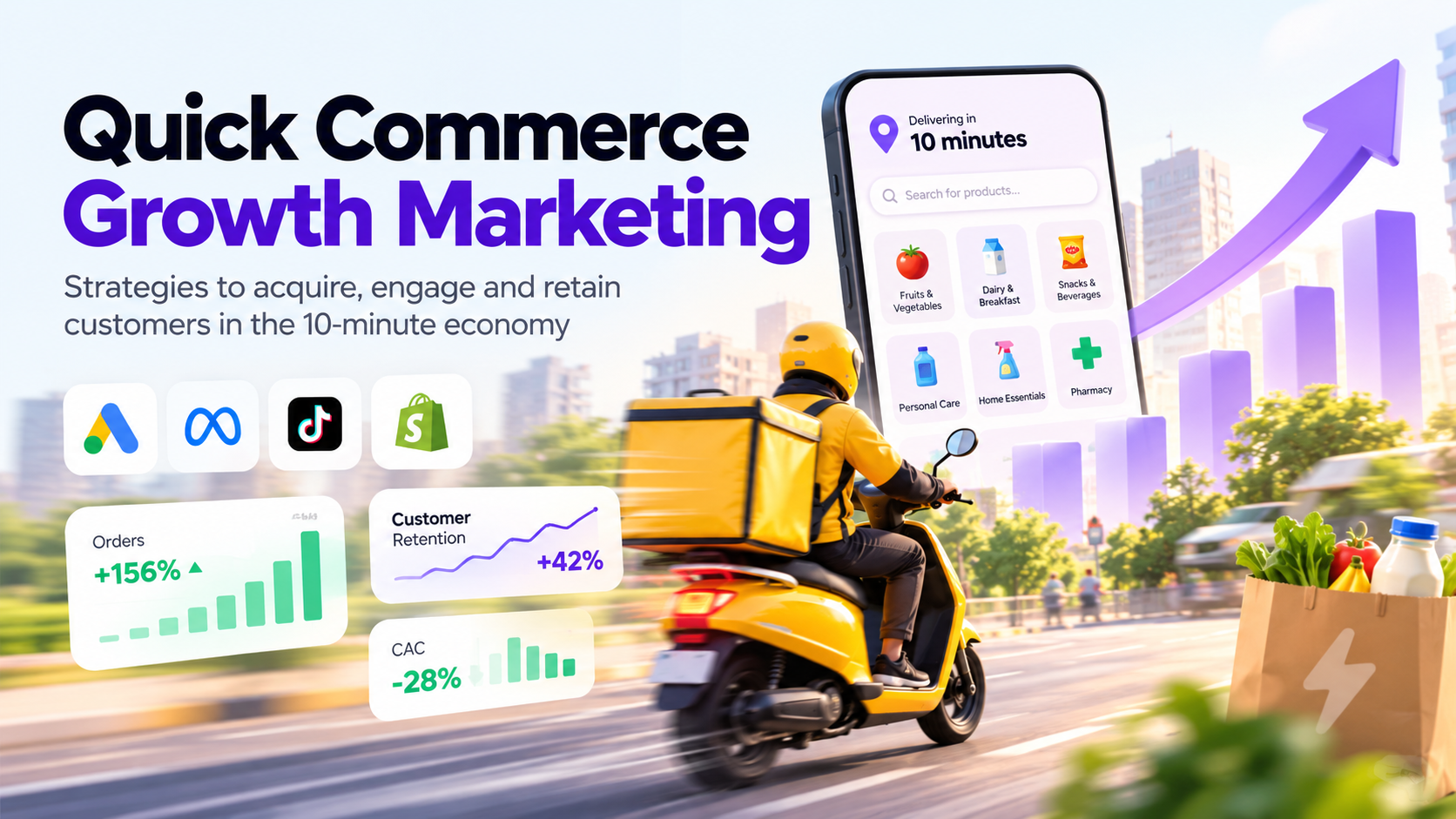
Quick commerce (q-commerce) is a retail model that delivers groceries, snacks, personal care and other everyday products in 10 to 30 minutes. Platforms such as Blinkit, Zepto and Swiggy Instamart make this possible by stocking fast-selling products in small neighbourhood warehouses called dark stores, a few kilometres from the customer, and delivering by two-wheeler.
In India, quick commerce has grown from a pandemic-era convenience into a major sales channel for FMCG and D2C brands. This guide explains what quick commerce means, how it works, how it differs from e-commerce, the leading platforms and their 2026 numbers, and what brands need to do to grow on it.
Key takeaways
- Quick commerce delivers in minutes, not days, using dark stores placed close to dense residential areas.
- India’s quick commerce market closed FY26 at about $13–14 billion, roughly 17% of online retail GMV, according to Redseer Strategy Consultants.
- Blinkit, Swiggy Instamart and Zepto lead the market, while Flipkart Minutes, Amazon Now and BigBasket’s BB Now are expanding fast.
- Growth is spreading beyond groceries into beauty, electronics, fashion and home categories.
- For brands, winning on quick commerce depends on dark-store availability, pack sizes, pricing and platform ads, not just getting listed.
What is quick commerce (q-commerce)?
Quick commerce is a type of e-commerce built around speed: customers order a small basket of everyday items on an app and receive it within minutes. The term is often shortened to q-commerce and is also called instant commerce or hyperlocal delivery.
Three features define quick commerce in India:
- Delivery in 10–30 minutes, compared with one to five days for standard e-commerce.
- Dark stores (also called micro-fulfilment centres) that serve a small radius of a few kilometres.
- A focused assortment of fast-moving products, usually a few thousand SKUs per store rather than the millions listed on a marketplace like Amazon or Flipkart.
How does quick commerce work?
Quick commerce works by moving inventory close to the customer before the order is placed. When a customer orders, the app routes it to the nearest dark store, where it is picked, packed and handed to a rider within minutes.
- Demand forecasting: Platforms use order data to predict what each neighbourhood will buy and stock each dark store accordingly.
- Replenishment: A larger city warehouse, often called a mother hub, refills dark stores regularly. In one Blinkit city network described by Indian Transport & Logistics News, the mother hub replenishes every dark store daily in the morning.
- Order placement: The customer orders on the app and the system assigns the nearest dark store with stock.
- Picking and packing: Staff pick items from shelves organised by speed and scan them into a bag.
- Last-mile delivery: A rider on a two-wheeler delivers the order, usually within a 2–3 km radius.
This model is efficient only where order density is high. That is why quick commerce is concentrated in metros: Redseer estimates that metros drive over 80% of quick commerce GMV, while 90-plus non-metro cities contribute just over 15%.
What is a dark store?
A dark store is a small warehouse that is closed to walk-in shoppers and exists only to fulfil online orders quickly. Dark stores are the backbone of quick commerce because they keep inventory within minutes of the customer.
Dark stores stock only products with high sales velocity, so shelf space is limited and competitive. Brands that sell slowly in a city risk being delisted from that city’s stores. According to research firm Bernstein, as reported by TechCrunch in April 2026, more than 6,000 dark stores now operate in India.
Quick commerce vs e-commerce: what is the difference?
The main difference is delivery speed: quick commerce delivers in minutes from local dark stores, while e-commerce delivers in days from large regional warehouses. This one difference changes what people buy, how much they spend per order and how brands must plan inventory.
| Factor | Quick commerce | Traditional e-commerce |
|---|---|---|
| Delivery time | 10–30 minutes | 1–5 days (same-day in some cities) |
| Fulfilment | Dark stores within a few km | Large regional warehouses |
| Assortment | Thousands of fast-moving SKUs per store | Millions of SKUs |
| Typical purchase | Top-up, urgent and impulse buys | Planned purchases, bigger tickets |
| Average order value | About ₹460 (Redseer, Jan 2026) | Varies widely by category |
| Geography | Metros and Tier-1 cities, now expanding to Tier-2 | Pan-India, including Tier-3 and rural |
| Inventory planning for brands | City- and store-level | National or regional |
The average order value figure comes from Redseer’s January 2026 benchmark, measured after MRP discounts and excluding delivery fees.
What are the main quick commerce platforms in India?
The leading quick commerce platforms in India are Blinkit, Swiggy Instamart and Zepto, followed by newer entrants Flipkart Minutes, Amazon Now and BigBasket’s BB Now. The table below shows each platform’s latest reported dark store network.
| Platform | Parent company | Dark stores | Cities | As of |
|---|---|---|---|---|
| Blinkit | Eternal (formerly Zomato) | 2,443 | 240+ | June 2026 |
| Swiggy Instamart | Swiggy | 1,171 | 131 | June 2026 |
| Zepto | Zepto (Kiranakart Technologies) | 1,139 | 66 | March 2026 |
| Flipkart Minutes | Flipkart (Walmart) | About 1,000 | 130 | July 2026 |
| Amazon Now | Amazon | About 500–600 (UBS estimate) | Expanding | 2026 |
| BB Now | BigBasket (Tata Digital) | Not disclosed | Expanding | 2026 |
Blinkit is the market leader. It added 200 net dark stores in the April–June 2026 quarter, and has outlined plans to reach 3,000 dark stores by March 2027. Blinkit has also been moving to an inventory-led model, where it buys and holds stock itself.
Swiggy Instamart reported gross order value of ₹7,907 crore in Q1 FY27 and reached contribution-margin breakeven in May 2026, according to Swiggy’s shareholder letter as reported by Inc42.
Zepto filed its updated draft IPO papers with SEBI in June 2026. As of March 2026, Zepto stocked over 46,000 SKUs at the local fulfilment level and handled more than 2.3 million orders a day, as reported by Groww.
Flipkart Minutes and Amazon Now entered in 2024 and are scaling quickly. Flipkart Minutes says about 90 of its 130 cities are Tier-2 and Tier-3 markets, making it the most Bharat-focused of the large players.
How big is the quick commerce market in India?
India’s quick commerce market was worth about $13–14 billion in FY26, roughly 17% of total online retail GMV, according to Redseer. Redseer projects that quick commerce will make up 25–30% of online retail GMV by FY30.
Other data points show the pace of growth:
- Monthly quick commerce GMV reached about ₹11,000 crore in January 2026, up roughly 100% year on year, on about 7.8 million orders a day (Redseer).
- Zepto’s IPO filing cites industry GMV of $11.3 billion in calendar 2025, expected to grow five to seven times to $60–83 billion by 2030 (Upstox).
- In packaged food and beverages alone, Redseer expects quick commerce GMV to grow from about $4 billion to more than $25 billion by 2030.
Market-size estimates vary because firms measure different things (GMV, GOV or revenue) over different years (fiscal or calendar). The direction is consistent: quick commerce is growing far faster than overall e-commerce.
Why is quick commerce growing so fast in India?
Quick commerce is growing fast in India because it fits how urban Indians already shop: frequently, in small baskets, from nearby stores. Platforms have made that habit faster and more convenient on a phone.
- Dense cities: High population density lets a single dark store serve thousands of orders a day profitably.
- Top-up shopping habits: Indian households traditionally buy daily needs from the neighbourhood kirana; quick commerce digitises that behaviour.
- Affordable last-mile delivery: Two-wheeler fleets keep per-order delivery costs workable.
- UPI and smartphones: Instant payments remove friction from small orders.
- Wider assortments: Platforms now sell electronics, beauty, toys, home goods and gifting, raising order values and frequency.
What products sell best on quick commerce?
Grocery, packaged food, beverages, dairy, personal care and household essentials still form the core of quick commerce. Non-grocery categories are now growing faster: Redseer found non-grocery grew about 1.6 times faster than grocery in January 2026, led by beauty, electronics, fashion, mobiles and home.
Products that perform well on quick commerce usually share these traits:
- High purchase frequency (snacks, beverages, milk, detergents).
- Urgency or impulse value (ice cream, chocolates, party supplies, chargers, medicines that are allowed to be sold).
- Compact pack sizes that fit limited dark-store shelves.
- Price points suited to small baskets, often under ₹500.
Categories with low quick commerce penetration are an opportunity: Redseer notes quick commerce is still under 5% of online sales in fashion, mobiles and electronics.
Quick commerce business models: how do platforms work with brands?
Quick commerce platforms in India use two main models to source products from brands: inventory-led and marketplace. The model decides who owns the stock, who sets the price and how a brand gets paid.
| Model | How it works | What it means for brands |
|---|---|---|
| Inventory-led | The platform (or its sourcing entity) buys stock from the brand through purchase orders and sells it to customers. | Brand earns on a margin agreed with the platform; the platform controls availability and much of the pricing. |
| Marketplace | Brands or their sellers list products and own the inventory placed in dark stores; the platform charges commissions and fees. | Brand keeps more pricing control but carries inventory risk and must manage replenishment. |
Many brands work with a mix, depending on platform and category. Commission rates, margins and fees differ by platform and category and change often, so confirm current terms on each platform’s seller or brand portal.
What are the benefits of quick commerce?
For consumers, the main benefit is convenience: essentials arrive in minutes without a trip to the shop. For brands, the main benefit is reach and speed to market in India’s most valuable urban households.
Benefits for brands:
- Fast distribution in metros without building a traditional distributor network city by city.
- Discovery for new brands, through in-app search, category pages and sponsored placements.
- Sharp data: city-, store- and SKU-level sales data shows what is working within days.
- Impulse sales from higher-visibility placements at checkout and on the home screen.
- Quick launches of new products and pack sizes, with fast feedback.
What are the challenges of quick commerce?
The biggest challenges in quick commerce are thin margins, high costs and intense competition for limited dark-store shelf space. Both platforms and brands face these pressures.
- Platform profitability: Dark stores are expensive to run. Platforms have added platform, handling and small-cart fees to improve unit economics.
- Stockouts: Small stores run out quickly; a product that is out of stock loses search ranking and sales.
- Rising ad costs: Visibility increasingly depends on paid placements, which can erode margins without disciplined ROAS tracking.
- Metro concentration: Expanding into smaller cities is harder because baskets are lighter and orders less dense.
- Working capital: Brands need inventory spread across many cities and stores at once.
How can brands grow on quick commerce? A 7-step playbook
Brands grow on quick commerce by getting listed in the right cities first, keeping stock available in every dark store, and then using platform ads to win search. Here is the playbook our team at Stryder Consulting uses with consumer brands:
- Pick the right platforms and cities. Start where your target customers and category demand are strongest, usually two or three metros.
- Get onboarding right. Keep GST registration, trademark details, FSSAI licence (for food and beverages) and compliant labelling (including Legal Metrology declarations) ready, with clean product data and images.
- Build a quick-commerce assortment. Lead with your fastest-selling SKUs and create small, trial-friendly pack sizes.
- Optimise listings for in-app search. Use the keywords shoppers actually type, clear titles, strong main images and accurate attributes.
- Protect availability. Track stock at city and dark-store level and replenish before you run out; availability is the single biggest driver of quick commerce sales.
- Run platform ads with clear ROAS targets. Use search ads, banners and category placements, and shift budgets weekly toward the keywords and cities that convert.
- Review the numbers every week. Track sales, margins, ad spend and availability by SKU, city and platform, and cut what does not work.
To see how we run this end to end, explore our quick commerce growth services.
Which metrics should brands track on quick commerce?
The most important quick commerce metrics are availability, sales velocity and return on ad spend, tracked at SKU and city level. These numbers tell you whether you are in stock, selling fast enough to keep your shelf space, and paying a sensible price for visibility.
| Metric | What it measures | Why it matters |
|---|---|---|
| Availability (in-stock %) | Share of dark stores where your SKU is in stock | Out-of-stock SKUs lose search rank and sales |
| Sales velocity | Units sold per store per day | Low velocity risks delisting |
| Share of search | Your visibility for key category keywords | Shows whether shoppers find you before competitors |
| ROAS | Revenue per rupee of ad spend | Keeps paid growth profitable |
| Average selling price and discount depth | Price after offers | Protects margin and brand positioning |
| Contribution margin by platform | Profit after platform fees, ads and logistics | Shows which platforms and cities to scale |
What is the future of quick commerce in India?
The future of quick commerce in India points to more cities, more categories and more competition. Flipkart Minutes aims for about 1,500 fulfilment centres by the end of 2026, while Amazon Now is adding stores rapidly, and the established players continue to expand.
Expect four shifts over the next few years:
- Tier-2 and Tier-3 expansion, led by Flipkart Minutes and Blinkit.
- Bigger baskets as electronics, beauty, fashion and gifting grow.
- A sharper focus on profitability, with fewer discounts and more fees.
- Retail media growth, as platforms earn more from brand advertising and brands compete harder for visibility.
How Stryder Consulting helps brands grow on quick commerce
Stryder Consulting is a Bengaluru-based growth consulting firm that helps consumer brands get onboarded and scale on Blinkit, Zepto, Swiggy Instamart, BigBasket, Amazon and Flipkart. We treat quick commerce as a full P&L, not just a listing exercise.
- Onboarding: account setup, documentation, catalogue and listing readiness across platforms.
- Assortment and pricing: choosing the right SKUs, pack sizes and price points for each platform.
- Ads and visibility: sponsored placements, search ads and share-of-search tracking with clear ROAS targets.
- Analytics and reporting: weekly dashboards on sales, availability, ad spend and margin by city and SKU.
Our team has scaled 35+ brands across quick commerce, e-commerce and D2C. Learn more about our quick commerce and e-commerce growth services.
Frequently asked questions about quick commerce
What is the meaning of quick commerce?
Quick commerce means delivering everyday products such as groceries, snacks and personal care items within 10 to 30 minutes of ordering. It is a faster form of e-commerce that relies on small local warehouses called dark stores and two-wheeler delivery. In India, Blinkit, Zepto and Swiggy Instamart are the best-known quick commerce apps.
What is the full form of q-commerce?
Q-commerce stands for quick commerce. The term describes online retail that delivers small baskets of products in minutes rather than days. It is sometimes also called instant commerce, hyperlocal commerce or 10-minute delivery. In India, q-commerce platforms include Blinkit, Zepto, Swiggy Instamart, Flipkart Minutes, Amazon Now and BigBasket’s BB Now.
What is the difference between quick commerce and e-commerce?
Quick commerce delivers in 10–30 minutes from dark stores near the customer, while e-commerce usually delivers in one to five days from large regional warehouses. Quick commerce focuses on a few thousand fast-moving products for urgent or top-up needs. E-commerce offers millions of products for planned purchases across most of India.
Which is the largest quick commerce company in India?
Blinkit, owned by Eternal (formerly Zomato), is the largest quick commerce platform in India. It operated 2,443 dark stores at the end of June 2026, more than twice the network of Swiggy Instamart or Zepto. Blinkit has outlined plans to reach about 3,000 dark stores by March 2027.
How big is the quick commerce market in India?
India’s quick commerce market was worth about $13–14 billion in FY26, roughly 17% of online retail GMV, according to Redseer. Monthly GMV reached about ₹11,000 crore in January 2026, nearly double the previous year. Estimates differ between research firms because they measure GMV, GOV or revenue in different ways.
Is quick commerce profitable?
Quick commerce is moving towards profitability but remains margin-sensitive. Eternal, Blinkit’s parent company, reported a net profit in Q1 FY27, and Swiggy Instamart reached contribution-margin breakeven in May 2026. Platforms are improving economics through higher order values, more categories, advertising income and customer fees, while reducing heavy discounting.
How can a brand sell on Blinkit, Zepto or Instamart?
A brand can sell on Blinkit, Zepto or Instamart by applying through each platform’s brand or seller onboarding process with GST, trademark and, for food, FSSAI documents. After approval, the brand lists products, agrees commercial terms and sends stock to the platform’s warehouses. Growth then depends on availability, pricing and in-app advertising.
Which products sell best on quick commerce?
The best-selling quick commerce products are high-frequency, urgent or impulse items: snacks, beverages, dairy, ice cream, personal care, household essentials and small electronics accessories. Compact pack sizes and prices suited to small baskets perform best. Beauty, electronics, fashion and home products are now growing faster than grocery on most platforms.
Conclusion
Quick commerce has changed how urban India shops, turning 10-minute delivery from a novelty into a habit. For brands, it is now one of the fastest routes to India’s highest-spending households, but success depends on availability, the right assortment and disciplined advertising, not just a listing.
If you want to launch or scale your brand on Blinkit, Zepto, Swiggy Instamart or other quick commerce platforms

Nidhi Bhasin is the Founder of Stryder Consulting, where she helps brands turn digital marketing into measurable revenue growth. She has previously driven growth and built digital marketing teams and operations for brands including Flipkart, Google, YouTube, Café Coffee Day and TVS Motor.
She writes about D2C growth, performance marketing, quick commerce, SEO, CRO and the strategies that move businesses beyond vanity metrics to real revenue.